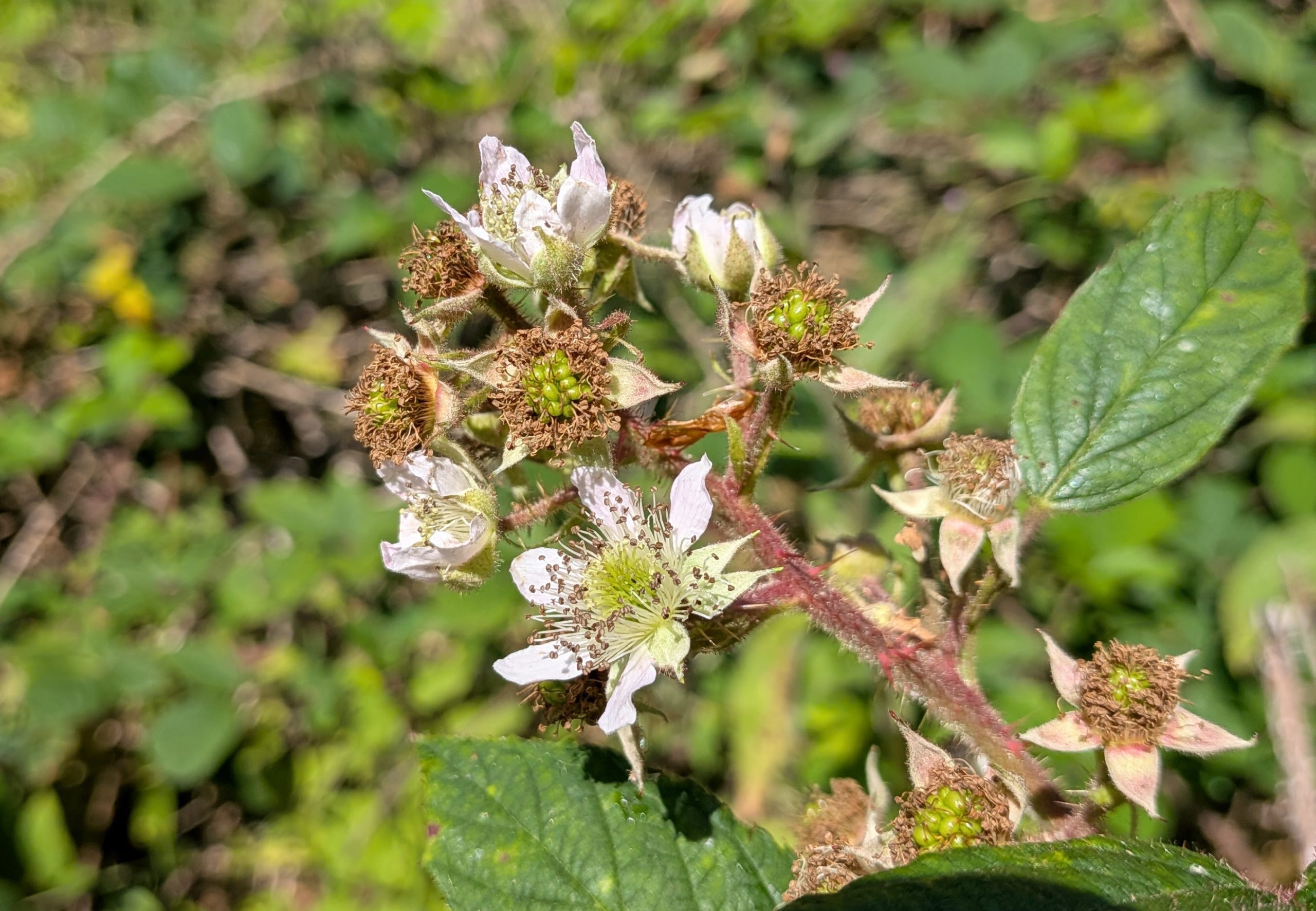
Brambles (Rubus) are a fascinating and varied group. They are also one which as seen great strides recently in terms of the availability of resources to support identification and ecology. This page is as much a landing point for my own memory than anything else and to avoid me duplicating the work of others.
The Flora of South Lancashire (NWNU)
The Flora of South Lancashire covers the whole of VC59 and runs to 2025. It is a comprehensive summary of vascular plants in the vice-county produced by the North West Naturalist Union vascular plant section. Rubus are included as individual species (including several undescribed) and each has a distribution map, species account and photo.
VC59 Flora: https://northwesternnaturalistsunion.org.uk/?page_id=2586
Rubus pages: https://northwesternnaturalistsunion.org.uk/wp-content/uploads/2025/01/VC59-048B-Rosaceae-Rubus-31-01-2025.pdf
Brambles of the British Isles (JN Ecology)
This is an excellent photo-library of many of the British Rubus. Great for referencing against if you think you know what you have. Some also contain species accounts highlining ecology or habitat associations.
Landing page: https://www.jnecology.uk/rubus/index.html
The Brambles of Scotland (BSBI)
A recent book on the Brambles of Scotland, published as a handbook by the BSBI. Including many species that occur in the North of England. A great recent resource with new key(s) and descriptions for each of the species included. The book and keys have been produced collaboratively by the author with other specialists.
Costs £10 via BSBI: https://bsbi.org/learn/publications/ebooks/handbook-25
Key to Subgenus (BSBI)
The Edees and Newton key to subgenus along with some introductory information on collection and identification. Useful starting point and grounding.
https://bsbi.org/learn/resources/plant-crib/rubus
Atlas of British and Irish Brambles (BSBI)
Published 2004 – “A phytogeographical analysis of microspecies of Rubus sect. Rubus & sect. Corylifolii, including 330 distribution maps with summaries of distribution, notes on changes and phytogeographical analyses.
The book additionally includes information on species described between 1988 and 2002, a composite map of 50 common R. fruticosus microspecies, hectad distribution maps, bibliography, index and vice-county map and list.”
Cost £10 eBook: https://bsbi.org/learn/publications/ebooks/atlas-of-british-and-irish-brambles
Identikit Multi-access Key (David Earl)
Multi-access Key based on Bramble features, under development by David Earl


 using WordPress and
Comments are closed