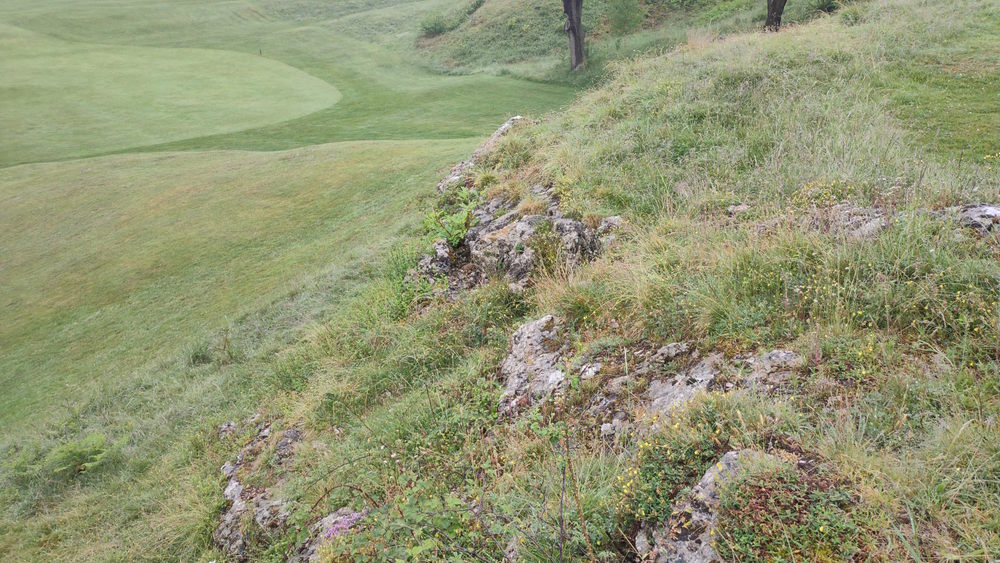
Some surveys begin gently, under gentle wind and warming sunlight. This one didn’t. The Golf Course greeted me with two days of relentless rain — the kind that soaks through waterproofs, numbs your fingers, and makes every limestone outcrop shine like polished steel. But even through the downpour, the site revealed itself as something far richer than a typical golf course. Beneath the fairways and tees lies a network of three Biological Heritage Sites, each holding fragments of rare limestone grassland, scrub, and woodland in between the green, fairways, and rough.
I’d been introduced to the site earlier in the month by Mick who had kindly taken me around in a expertly guided golf buggy to pick out the areas best to target for field work, but this week was my first chance to explore it properly. The aim was simple: assess the state of the calcareous grassland and update our understanding of the site’s botanical value. The reality, as always, was more complicated — and far more rewarding.
A Survey in the Rain
Monday set the tone. Six hours of unbroken rain, the kind that runs down your sleeves, makes it through your waterproof trousers and fills your normally solid hiking boots. By the end of the day I was soaked, freezing, and carrying half the course’s mud in my treads. But the weather also sharpened the senses. Colours were richer. The limestone gleamed. And the plants — especially the early‑season specialists — stood out vividly against the wet rock and grass.
The habitats were mixed: patches of calcareous grassland perched on limestone outcrops, surrounded by hawthorn scrub, secondary woodland, and transitional edges where one habitat blurred into the next. The site is listed for a range of rare limestone species, but the existing information for the listed site was sparse. In many ways, I was surveying blind — relying on instinct, experience, and the occasional lucky stumble, oh how i love to stumble..
Finding the Grasslands Worth Fighting For
Despite the uncertainty, the best areas of grassland eventually revealed themselves. And when they did, they were worth every soaked hour.
Across the limestone outcrops, I found:
- Spring Cinquefoil (Potentilla pusilla) – Scarce in Britain
- Rare Spring-sedge (Carex ericetorum) – Scarce in Britain and Vulnerable in England
- Limestone Bedstraw (Galium sterneri)
- Blue Moor-grass (Sesleria caerulea) – Scarce in Britain
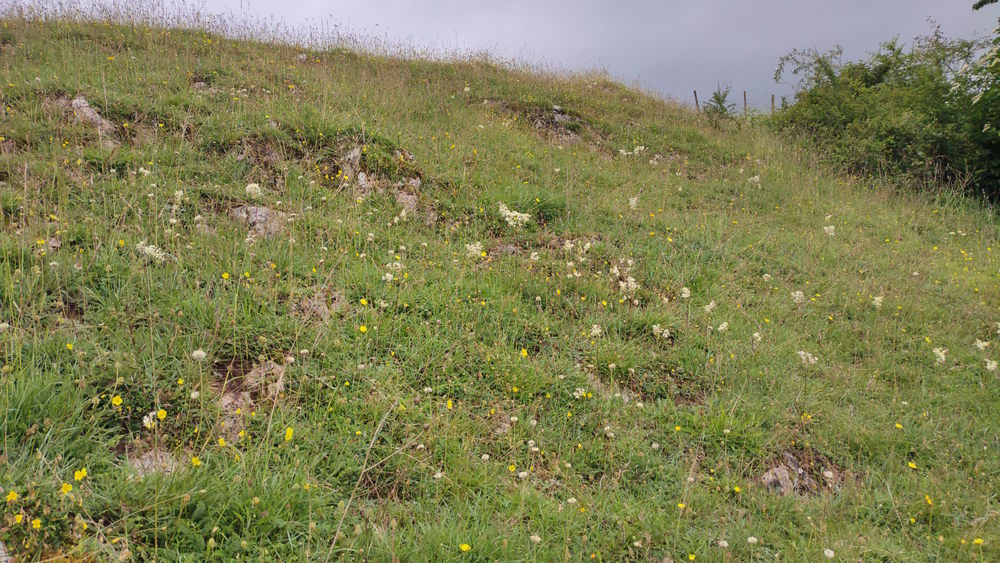
These are the species that define high‑quality calcareous grassland — plants that cling to thin soils, thrive in basic conditions, and disappear quickly when scrub takes hold.
And scrub is taking hold. Bramble (Rubus agg.) and Bracken (Pteridium aquilinum) are pushing into many of the grassland patches, shading out the specialists and threatening to smother the very features that make the site important. It’s a reminder that even managed sites need specialist and active care.
More widespread across the grassland were the familiar but still valuable species:
- Spring Sedge (Carex caryophyllea)
- Lady’s Bedstraw (Galium verum)
- Knapweed (Centaurea nigra)
- Fairy Flax (Linum catharticum)
- Rock Rose (Helianthemum nummularium)
- Wild Thyme (Thymus drucei)
- Dropwort (Filipendula vulgaris)
Together, they created a tapestry of colour and texture — a sign that, despite the pressures, the grassland still holds its natural character.
A Surprise Beyond the Boundary
One of the most exciting discoveries came not within the designated areas, but just outside them. While following a line of scrub, I stepped into a patch of botanically rich marshy grassland — a habitat that hadn’t been recorded in the site’s official documentation.
It was a gem.
Under and around a stand of Red Poll ‑ grazed Sallow (Salix cinerea), the ground supported but was by no means limited to:
- Water Horsetail (Equisetum fluviatile)
- Cypress Sedge (Carex pseudocyperus)
- Wild Angelica (Angelica sylvestris)
- Marsh Bedstraw (Galium palustre)
- Bottle Sedge (Carex rostrata)
- Gypsywort (Lycopus europaeus)
It was diverse, healthy, and ecologically significant — exactly the kind of habitat that deserves recognition and protection. I’m now hoping to see this area included within the site’s designation in future.
Why This Survey Matters
This survey wasn’t just about ticking species off a list. It was about understanding the site properly, so that future conservation advice is grounded in reality rather than assumptions. The findings will help refine how the site is managed — from scrub control to grazing regimes — and will support the landowner in making decisions that benefit both the course and its wildlife.
Silverdale Golf Course is more than a recreational space. It’s a patchwork of rare habitats, shaped by limestone, weather, and centuries of ecological processes. With the right care, it can continue to support the species that make this landscape special.
Leaving With Muddy Boots and a Clearer Picture
By the end of the second day, the rain had eased, my camera roll was full, and I had a far clearer understanding of the site’s ecological value. The survey may have left me cold and soaked, but it also left me optimistic. There is real potential here — not just to protect what remains, but to restore and expand it.
And that, in the end, makes every wet hour worth it.


 using WordPress and
Comments are closed